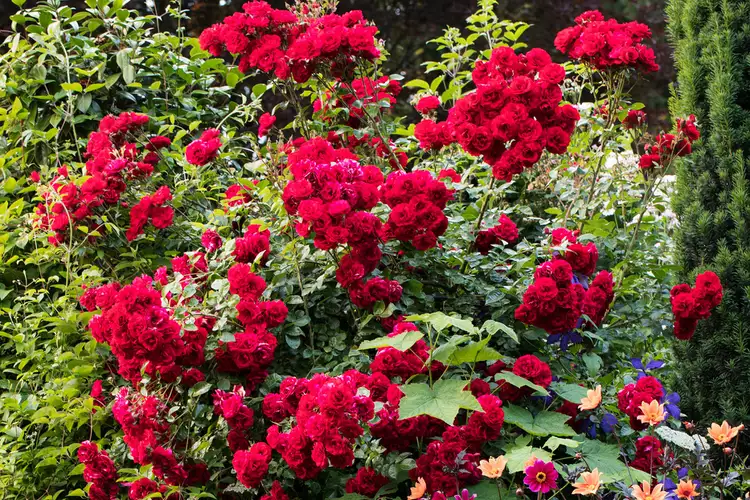
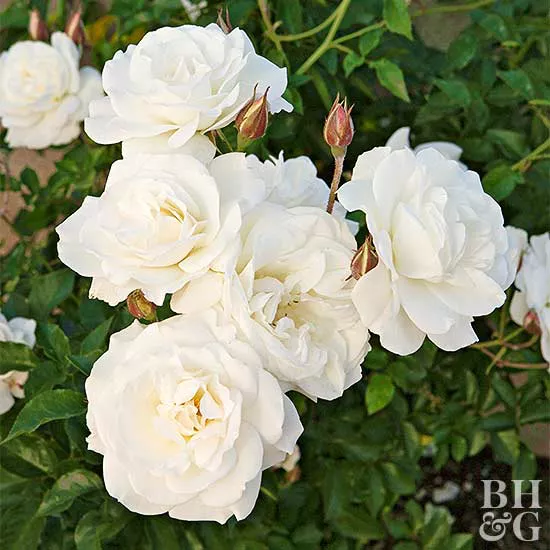
Floribunda roses offer a bouquet on every branch. The small flowers look like elegant hybrid tea blooms but appear in clusters instead of one flower per stem. Floribundas are a cross between polyantha species roses and hybrid teas, combining hardiness, free flowering, and showy, usually fragrant blooms. Sizes of these hardy roses vary from compact and low-growing to a more open habit and heights of 5-6 feet, ideal for hedges. A floribunda rose is a low-maintenance plant that delivers maximum impact with its continuous bloom cycles.
Floribunda Rose Overview
| Genus Name | Rosa |
| Common Name | Floribunda Rose |
| Plant Type | Rose |
| Light | Sun |
| Height | 2 to 6 feet |
| Width | 2 to 6 feet |
| Flower Color | Orange, Pink, Red, White, Yellow |
| Foliage Color | Blue/Green |
| Season Features | Fall Bloom, Spring Bloom, Summer Bloom |
| Special Features | Fragrance, Good for Containers, Low Maintenance |
| Zones | 4, 5, 6, 7, 8, 9 |
| Propagation | Stem Cuttings |
| Problem Solvers | Good For Privacy, Slope/Erosion Control |
Where to Plant Floribunda Rose
Plant floribunda roses in full sun in a location that blocks the wind. They don't do well in shade or when they are crowded by other plants, but they are lovely planted in groups of three or more. These low-growing shrub roses fill garden spaces with nonstop blooms and serve as an excellent groundcover when planted in well-draining, rich soil. They also do well in containers.
How and When to Plant Floribunda Rose
Although floribunda roses in nursery containers can be planted at any time of year, the best time to plant them is from early fall to early spring when they are dormant. Prepare the garden bed by double-digging it to improve aeration. If the soil isn't well-draining, amend it with compost or well-rotted organic matter. Then dig a hole twice the width but the same height as the container. Remove the rose and spread its roots loosely in the hole. Position the graft (the bulge at the top of the roots) at soil level. Backfill with the amended soil, press down lightly with your hands, and water the plant.
If you are planting bare-root roses, plant them from mid winter to spring in amended soil (double-digging it as with container roses). Don't plant them when the ground is frozen or waterlogged. Soak a bare root floribunda rose in water for a couple of hours before planting. Dig a hole about 18 inches by 18 inches and position the rose so that the roots spread loosely and the graft is at soil level. Backfill with soil and lightly press down with your hands. Water the plant.
Floribunda Rose Care Tips
As roses go, floribunda roses are relatively tough shrubs that are low-maintenance when their basic needs are met.
Light
Floribunda roses thrive in full sun and won't perform well in shade.
Soil and Water
For the best flower production, plant floribunda roses in well-draining soil that is amended with compost and organic matter. Roses require frequent watering (1-2 inches weekly unless it rains) but don't like soggy soil. When watering, keep the water off the leaves if possible to reduce the chance of a fungal infection.
Temperature and Humidity
Floribunda rose shrubs can tolerate brief periods as cold as 10°F, but for an extended time at this temperature or colder, they need some protection. They tolerate temperatures as high as 90°F to 100°F. Normal humidity is all they need, but they do well in high-humidity situations.
Fertilizer
Fertilize newly planted floribunda roses about a month after planting with a liquid rose fertilizer, following the product directions. Fertilize them again when new growth is 6 inches long and yet again right after the plant starts blooming. Repeat every three weeks until late summer.
Pruning
Most floribundas require a little spring pruning—a general shearing to tidy the shape of the shrub and the removal of dead or damaged wood or thinning of crowded branches. Don't worry about the usual wisdom of cutting just above a node. There are so many nodes, it doesn't matter. Deadhead throughout the summer, being careful not to remove flower buds.
Potting and Repotting Floribunda Rose
Grow small floribunda roses (those only 2 feet tall) in containers when you have limited space in the garden. They brighten up any patio or balcony. Use a mixture of 2/3 potting soil and 1/3 compost in a deep container with drainage holes. Position them to receive at least six hours of sun daily.
If you need to repot a rose, do it while the plant is dormant in the winter and replace the potting soil with a fresh mix.
Pests and Problems
The foliage on floribunda roses tends to shrug off most diseases unless it is in a particularly damp environment, but occasionally it will display evidence of fungal disease, sooty mold, black spot, or powdery mildew. Treat all of these with neem oil.
Aphids are the most common floribunda rose pest. They particularly like the buds. Prevent damage by spraying the rose bush with neem oil. The same treatment can also control mealybugs, spider mites, and weevils.
How to Propagate Floribunda Rose
Gardeners can propagate their favorite floribunda rose via stem cuttings, but unless the rose is native, not grafted, the resulting plant might disappoint. If you want to give it a try anyway, take 8-12 inch long new-growth cuttings in spring, cutting just below a stem node. Remove all the leaves and buds except for the top two sets of leaves. Dip the bottom half of the cutting into rooting powder, wetting the stem first so the powder will cling to it. Fill a small pot with at least 6 inches of rose potting soil and poke a hole in the center. Insert the stem, being careful not to rub off the rooting powder. Press the soil to hold the cutting upright and water.
Loosely cover the pot and cutting with a plastic bag. Don't seal it and keep it off the cutting's leaves, using supports if necessary. Keep the soil moist, not wet. The roots will form in two to eight weeks. Check by very gently tugging on a leaf. If you feel resistance, the cutting has rooted. Remove the plastic bag. After new leaves start to grow, replant the cutting in a larger pot.
Note: Please don't attempt to propagate patented roses; that infringes on the owner's patent. There are a great many unpatented roses you can propagate.
Types of Floribunda Rose
'Amber Queen' Rose
Rosa 'Amber Queen' bears clusters of cupped double flowers in a medium yellow and possesses a strong spicy-sweet fragrance. The plant stays compact, growing to 2½ feet tall and wide and is hardy in Zones 6-9.
'Angel Face' Rose
Rosa 'Angel Face' shows strong disease resistance, an improvement on lavender roses. The ruffled blooms have a strong citrusy scent. The plant grows 2-3 feet high and is hardy in Zones 5-9.
'Blueberry Hill' Rose
Rosa 'Blueberry Hill' features unique pale lilac semidouble blooms that smother the plant's glossy dark green foliage early in the season and then continuously until fall. The flower fragrance is reminiscent of a sweet apple. The rounded plants show great vigor and disease resistance. They grow 4-5 feet tall and wide and are hardy in Zones 5-11.
'Cinco de Mayo' Rose
Rosa 'Cinco de Mayo' is an award-winning selection honored for its nonstop flower production, spicy color blend, and disease resistance. The clustered blooms feature a smoky mix of russet and lavender with coral highlights. Their fragrance is like a tart apple. 'Cinco de Mayo' grows 3-4 feet tall and is hardy in Zones 5-9.
'Hot Cocoa' Rose
Rosa 'Hot Cocoa' is another unique-color, award-winning variety. The blooms feature a smoldering color combination of cinnamon and pepper red, with a purple shimmer on the petals. It grows 4-5 feet tall and is hardy in Zones 5-9.
'French Lace' Rose
Rosa 'French Lace' offers classic urn-shape ivory to apricot buds that open to large, full flowers of a warm ivory tone. The fragrance is delicate. Flowers open on an upright plant that grows 3 feet tall and is disease resistant. Zones 4-9
'Honey Perfume' Rose
Rosa 'Honey Perfume' features clustered apricot-yellow blooms on a disease-resistant plant. The fragrance is like a mixture of honey and spice. It grows 3-4 feet tall and is hardy in Zones 5-9.
'Iceberg' Rose
Rosa 'Iceberg' is one of the most popular landscaping roses. It sets continuous drifts of small, clustered double-white flowers from late spring through fall. The blooms have a light, sweet fragrance. The plant grows 4-6 feet tall and wide and is hardy in Zones 5-9.
'Livin' Easy' Rose
Rosa 'Livin' Easy' bears big apricot blooms that deepen to orange in full flower. The fragrance is moderate and fruity, and the foliage is glossy. The weather-tolerant plant is resistant to fungal diseases and grows 4-5 feet tall. 'Livin' Easy' is hardy in Zones 5-9.
'Nearly Wild' Rose
Rosa 'Nearly Wild' is a shorter floribunda rose that works well as a groundcover or low hedge. Clusters of single rose-pink flowers with a light apple scent cover the vigorous, rounded plant and repeat continuously through the season. It grows 2-4 feet tall and is hardy in Zones 4-9.
'Scentimental' Rose
Rosa 'Scentimental' is a contemporary rose with peppermint-stripe petals that hearken back to gallica species roses. The blooms have a strong old-rose fragrance. The hardy plants grow to 4 feet tall in Zones 5-9.
'Sexy Rexy' Rose
Rosa 'Sexy Rexy' offers perfectly shaped, large, clear-pink blooms that unfurl layer after layer of petals. The clustered bouquets almost smother the glossy foliage, especially in the season's first flower flush. They're scented with a light tea-rose perfume. This variety is known to be very disease resistant. It grows 3½ feet tall and is hardy in Zones 5-9.
'The Fairy' Rose
Rosa polyantha 'The Fairy' puts on a constant show of dainty double-pink flowers on arching canes early in the season until frost. It grows 2-3 feet tall and 4-5 feet wide in Zones 4-9.