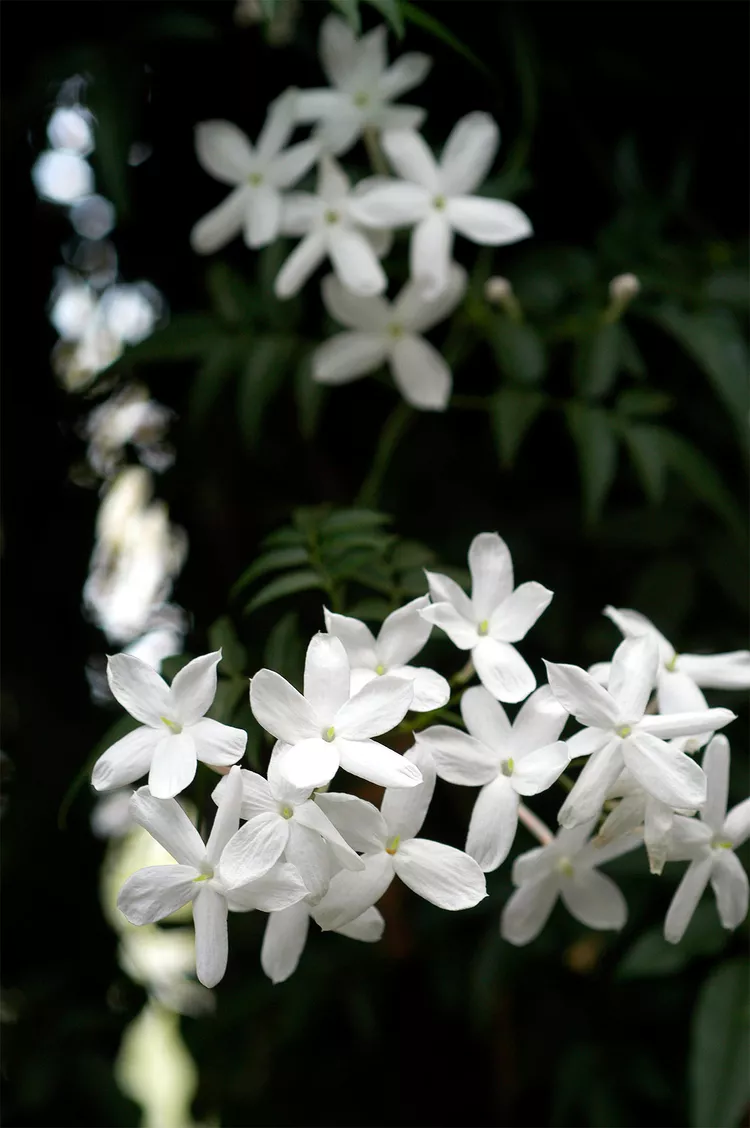
Few plants are as well-known for their intoxicating fragrance as jasmine. The small, numerous blossoms of this perennial vine or shrub are often intense enough to fill a room with scent and can be enjoyed from several yards away. Many species and styles of jasmine are available, most of which make a delightfully fragrant addition to the garden.
If your climate is too cold to grow jasmine outdoors, there is also the option to grow it as a houseplant.
Jasmine Overview
| Genus Name | Jasminum spp. |
| Common Name | Jasmine |
| Plant Type | Houseplant, Shrub, Vine |
| Light | Part Sun, Sun |
| Height | 3 to 8 feet |
| Width | 3 to 15 feet |
| Flower Color | Pink, White, Yellow |
| Foliage Color | Blue/Green |
| Season Features | Fall Bloom, Spring Bloom, Summer Bloom, Winter Bloom |
| Special Features | Fragrance, Good for Containers, Low Maintenance |
| Zones | 10, 6, 7, 8, 9 |
| Propagation | Layering, Seed, Stem Cuttings |
| Problem Solvers | Deer Resistant, Good For Privacy, Groundcover, Slope/Erosion Control |
Where to Plant Jasmine
Jasmine grows in full sun to partial shade, but the summer-flowering varieties do best in a sunny area. Although all jasmine plants love sun, the vining types also benefit from a location that is sheltered from the wind with a trellis or fence to climb on. Jasmine is cold-hardy in Zones 7-10 and sometimes survives in Zone 6 with sufficient shelter.
In warm, tropical regions such as south Florida, jasmine grows vigorously to the point of being invasive. Many vining jasmines root wherever a stem piece touches the ground, creating dense mats of foliage.
How and When to Plant Jasmine
Plant jasmine in the garden anytime between early summer and late fall.
Dig a hole slightly larger than the nursery pot. If the soil has poor drainage, add compost or other organic matter before planting. Position the plant in the soil at the same level it was in the pot.
If you plan to train the jasmine to a fence or trellis, insert a bamboo guide near the plant to get it going in the right direction.
Spacing depends on the type and variety of jasmine you're growing and how quickly you want to cover an area with a vine or hedge. Consult your plant tag information to determine the best placement.
Jasmine Care Tips
Despite vigorous growth habits, jasmine plants are easy to grow in a garden setting or as a houseplant.
Light
The best flowering occurs in full sun, with much sparser blooms in shade. Many of the vining types will happily climb a trellis or lattice in full sun or part shade. As a houseplant, It does best with at least six hours of bright, indirect light.
Soil and Water
Jasmine needs well-drained, fertile garden soil that is consistently moist. If the soil doesn't drain well, incorporate organic matter before planting. The soil should be slightly acidic, with a pH between 5.5 and 7.0.
In the absence of rain, water jasmine once a week. Indoor or potted jasmine requires more frequent watering, as much as two to three times a week.
Temperature and Humidity
The cold tolerance of jasmine varies depending on the species but generally, the plant does not survive freezing temperatures for long. The ideal temperature range is between 60° and 75°F.
Fertilizer
Unless the soil is poor, jasmine plants in the garden don't need much additional fertilizer. Applying a fertilizer that is high in potassium, such as 9-3-6, when new growth shows in late winter or early spring increases the blooms. There is a special jasmine fertilizer for outdoor and indoor use, usually in liquid form. Mix it with water following the label instructions and apply at the usual watering time.
Pruning
Shrubby varieties of jasmine need regular pruning to maintain their shape and prevent them from turning gangly. Major pruning should be done after a heavy bloom but the plant can also be lightly pruned throughout the year.
Potting and Repotting Jasmine
Jasmine makes a delightful houseplant. Use a pot with large drainage holes and well-draining potting soil combined with bark or peat for acidity.
Jasmine only requires repotting to a pot one size up every three years or so when the roots emerge from the drainage holes. Fill the larger pot with fresh potting mix before transferring the plant. Water the transplant well to settle it in its new home.
Pests and Problems
The tantalizing fragrance of jasmine isn't appreciated only by gardeners. Although jasmine doesn't have a big problem with insects, it may attract spider mites and aphids, both of which can be treated with insecticidal soap or neem oil. If caterpillars cause a problem, use Bacillus thuringiensis (Bt) products to control them.
How to Propagate Jasmine
Jasmine is propagated from seed and by cuttings and layering. '
To start jasmine from seed, the trick is to soak the seeds for 24 hours before planting them in a moist seed-starting mix. Cover the pots with clear plastic and place them in direct sunlight in a warm location. Keep the soil evenly moist at all times.
To propagate it from cuttings, in the fall, take a 4- to 6-inch cutting. Remove any spent blooms and the lower leaves, leaving at least three upper leaves on the cutting. Dip the end of the cutting in rooting hormone and plant in damp potting soil. Place a large, clear plastic bag over the pot and put it in bright indirect light. The cutting should root in about four to six weeks.
Layering is a mostly hands-off process that works well with jasmine in spring or early summer. While leaving a stem attached to the plant, bend it down to the soil near the plant (or in a pot next to the plant). Push a section of the stem with leaves into the soil, leaving the stem tip above soil level. Press down on the soil to firm it. In time, the buried section of the stem will develop roots and can be removed from the parent plant and transplanted.
Jasmine has its peak scent at night. For tea, thousands of jasmine blossoms are layered between alternating layers of tea leaves at night . After four hours, the tea will absorb the scent to flavor the tea. In some cases, this process is repeated several times for a more intense flavor.
Types of Jasmine
The biggest difference between jasmine varieties is their growth habit. The most well-known types are vines. Shrubby jasmines are less aggressive than vines but require more maintenance.
Angel Wing Jasmine
Jasminum nitidum is a great plant for cascading over the edge of a container. Angel wing jasmine has fragrant, pinwheel-shaped flowers that are white with bold purple undersides. Zone 10-11
Primrose Jasmine
Jasminum mesnyi, also known as Japanese jasmine, grows as a climber or a shrub. Primrose jasmine has unscented lemon yellow flowers in winter and spring and sporadically during other times of the year. Zone 8-10
Arabian Jasmine
Jasminum sambac is an evergreen vine with fragrant white flowers throughout the year, though they appear heaviest in summer. While this species of jasmine is generally marketed as a shrub, it can be trained as a woody vine as well because of its loose, sprawling habit.This is one of the best jasmines to grow indoors. Zone 10-11
Jasminum sambac and Jasminum grandiflorum are the most commonly used jasmines in the fragrance industry. The flowers are usually picked early in the morning before the buds have fully opened when they have their maximum fragrance.
Winter Jasmine
Jasminum nudiflorum is the hardiest jasmine. It's a shrub with yellow flowers in late winter and early spring. Unlike most jasmines, it is not fragrant. Useful as a hedge, it grows 10 feet tall and wide. Zone 6-9
Pink Jasmine
Jasminum polyanthum is one of the most common vine-type jasmines, bearing clusters of many white, fragrant flowers in late winter and early spring. It is usually trained on a trellis and found in florist shops. Outdoors, it climbs 10 feet or more. Zone 9-10
New